


Introduction
For photography enthusiasts and professional creators alike, the 50mm prime is more than just a standard focal length—it is the definitive benchmark of an optical manufacturer's technological prowess. In the vast history of camera optics, Sony’s journey in the high-speed standard lens category tells a fascinating tale of evolution.
Sony’s interchangeable lens division inherited its core DNA from Minolta after absorbing and integrating its camera business in 2006. If we trace the lineage of Sony's 50mm F1.4 lenses, we can see a clear technological shift:
- AF 50mm F1.4 (1985 / A-Mount): A classic 6-element in 7-group Double Gauss design that launched alongside the world’s first successful autofocus SLR system, the Minolta α-7000. It remained a beloved long-seller for decades, even after transferring to the Sony brand.
- Planar T FE 50mm F1.4 ZA (2016 / E-Mount):* A 12-element in 9-group modern masterpiece engineered under the rigorous supervision of Germany’s legendary Zeiss.
- FE 50mm F1.4 GM (2023 / E-Mount): The subject of today’s analysis—an 14-element in 11-group ultra-high-performance prime representing Sony’s mature "Second Generation" mirrorless optics.
In recent years, Sony seems to have shifted its engineering focus away from its long-standing collaboration with Zeiss, leaning heavily into its proprietary, Minolta-rooted high-end lineage: the G Master (GM) series. Whether this transition reflects an internal changing of the guard at the executive level or an evolution in internal corporate dynamics, it is clear that the GM series represents the pinnacle of modern lens engineering. Today, we will dissect how Sony’s latest second-generation flagship standard prime performs under strict optical simulation.
Patent Literature Context
To uncover the true, unvarnished optical performance of this modern prime, we look to the international patent applications. A deep dive into WO2024/166548 reveals that Embodiment 1 (Example 1) features an optical design that is remarkably identical to the production version of the FE 50mm F1.4 GM.
Disclaimer: The design values and optical data simulated below are reconstructed based on an optimized analysis of the aforementioned patent literature. While they closely mirror the real-world architecture, they are theoretical simulations and do not guarantee exact correspondence with every production-line unit.
Lens Specifications & Scaling Philosophy
The physical and optical metrics of the production SONY FE 50mm F1.4 GM are summarized below:
- Angle of View: 47°
- Lens Construction: 14 elements in 11 groups
- Minimum Aperture: F16
- Minimum Focusing Distance: 0.38m
- Filter Diameter: 67mm
- Overall Length: 96mm
- Maximum Diameter: 80.6mm
- Weight: 516g
- Release Date: April 21, 2023
Our Proportional Scaling Philosophy
When evaluating optical designs across different formats (such as smartphone, medium format, or cinema lenses), LENS Review adheres to a strict foundational design philosophy to prevent misunderstandings caused by the absolute values of geometric aberrations. All systems are evaluated by proportionally scaling their longitudinal dimensions to a unified 35mm full-frame reference standard. Since this lens is natively designed for the 35mm full-frame format, the simulated metrics represent its direct, native optical capacity without conversion.
Cross-Sectional Optical Path
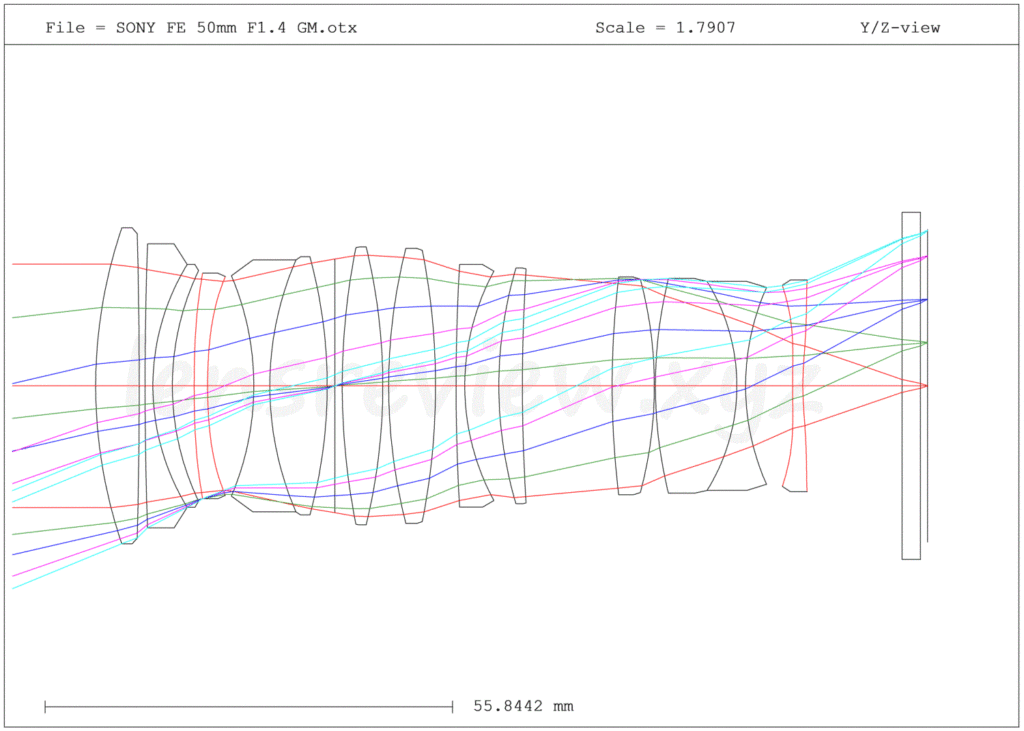
Utilizing our proprietary lens rendering application drawLens, we reconstruct the detailed cross-sectional optical path of the SONY FE 50mm F1.4 GM below.
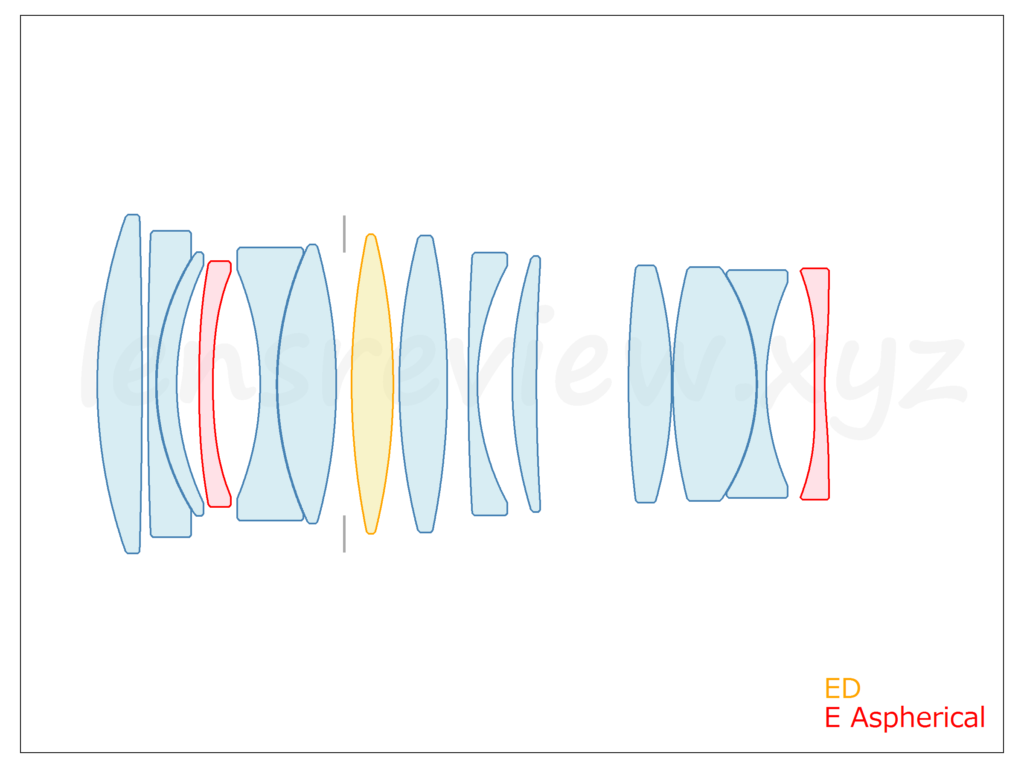
The lens architecture comprises a luxurious 14-element in 11-group configuration. To put this into perspective, it utilizes the exact same number of glass elements as its ultra-large-aperture sibling, the FE 50mm F1.2 GM, proving that Sony did not cut any corners in pursuit of the "G Master" badge.
The specialized material allocation includes:
- ED (Extra-low Dispersion) Glass Element (Highlighted in Yellow): 1 element, strategically positioned to suppress axial color fringing.
- Specialized Low-Dispersion Aspherical Elements (Highlighted in Red): 2 elements, simultaneously tasked with minimizing spherical aberrations, mitigating field curvature, and correcting geometric distortions.
For focusing, the design utilizes a linear system where the 9th and 10th lens elements move together as a single cemented unit. Interestingly, it does not adopt a complex floating focus mechanism, opting instead for a highly optimized, single-group focus drive.
Comprehensive Aberration Analysis
Spherical Aberration
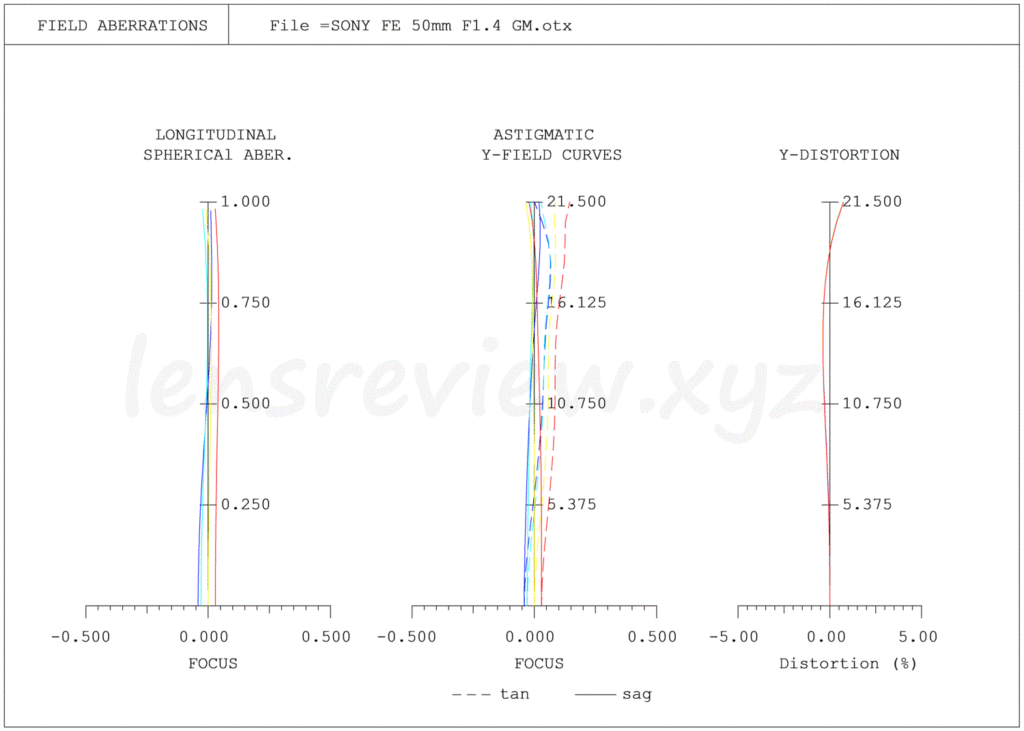
We begin our analysis at the center of the frame, where resolution and bokeh characteristics are dictated by spherical aberration. Given that we have already analyzed the older FE 50mm F1.2 GM, the results here are not entirely surprising, yet they remain deeply impressive. Spherical aberration is brilliantly corrected across the entire aperture radius, maintaining an exceptionally straight and controlled profile that promises both razor-sharp central contrast and beautifully smooth out-of-focus highlights.
Axial Chromatic Aberration
Axial chromatic aberration, which manifests as color bleeding or fringing in front of and behind the precise point of focus, is extremely well-controlled. The dispersion curves for the various reference wavelengths are tightly bound within a remarkably narrow corridor, keeping longitudinal color artifacts well below the threshold of human perception.
Field Curvature
Field curvature, the primary indicator of flatness across the entire image plane, is corrected to a degree of near-perfection. Both the sagittal and tangential image planes remain beautifully uniform from the center all the way out to the extreme corners of the full-frame sensor, ensuring that flat subjects like artwork or architectural details retain edge-to-edge crispness.
Distortion
In traditional Double Gauss standard lenses of the past, a native barrel distortion of around -2% was considered a normal, unavoidable characteristic. However, modern multi-element configurations have completely rewritten the rules. The SONY FE 50mm F1.4 GM achieves near-zero geometric distortion purely through its optical layout, leaving no noticeable warping in the raw image file.
Lateral Chromatic Aberration (Chromatic Aberration of Magnification)
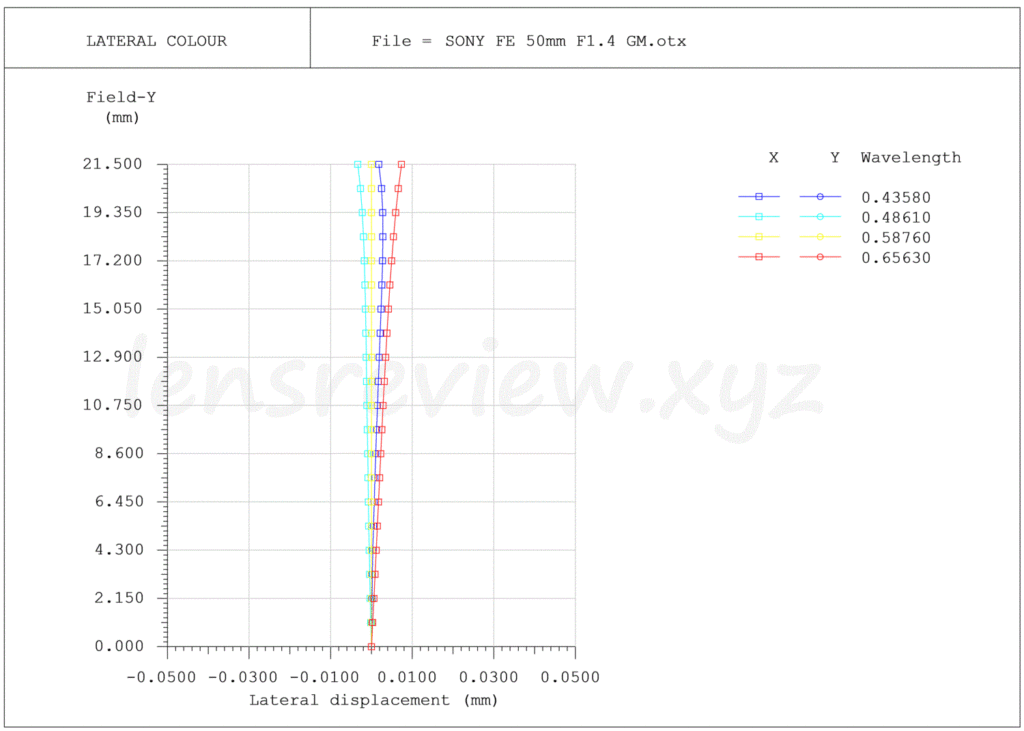
Lateral chromatic aberration, which causes color fringing along high-contrast boundaries near the periphery of the frame, is fully suppressed. While many modern mirrorless lenses deliberately leave lateral color to be handled by digital profile corrections in camera firmware, Sony’s optical formula chooses a purist approach, correcting this aberration natively via hardware. For astrophotographers and landscape shooters who demand uncompromised optical purity, this hardware-level correction is highly commendable.
Lateral Aberration (Transverse Aberration)
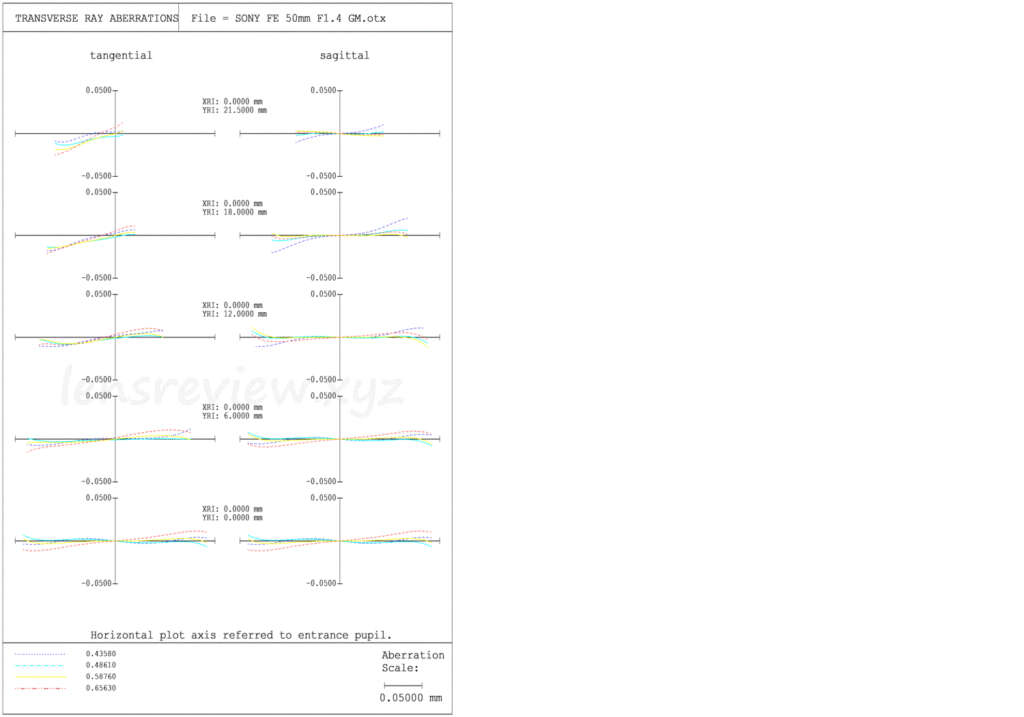
Examining the transverse aberration plots provides deep insight into how light rays converge at representative heights across the sensor. In the tangential direction (left column), the asymmetrical components responsible for coma flare are kept minimal. More astonishingly, in the sagittal direction (right column), the sagittal coma flare—often the bane of large-aperture primes—is virtually non-existent, ensuring that points of light remain perfectly round.
Spot Diagram Analysis
Standard Scale 0.3 Evaluation
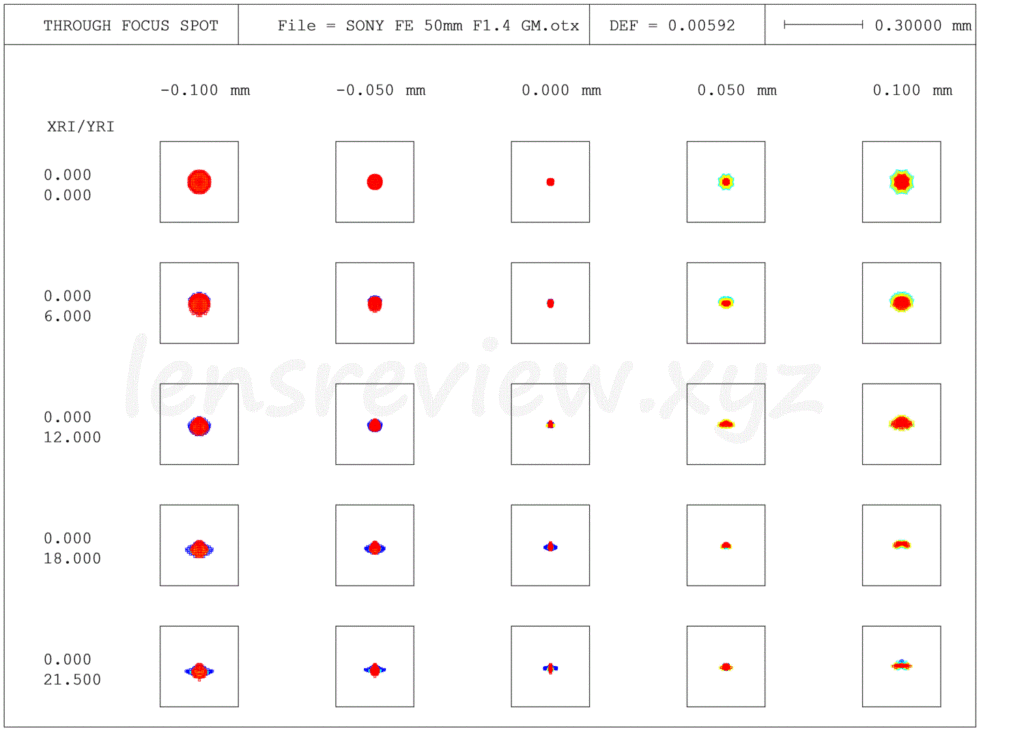
When viewed through our consortium's macro-level geometric scale, Standard Scale 0.3, the light ray concentration is so tightly packed that the actual structure of the spot is almost impossible to discern. The geometric scattering of rays is remarkably compact, indicating an exceptional baseline of optical definition.
Detail Scale 0.1 Evaluation
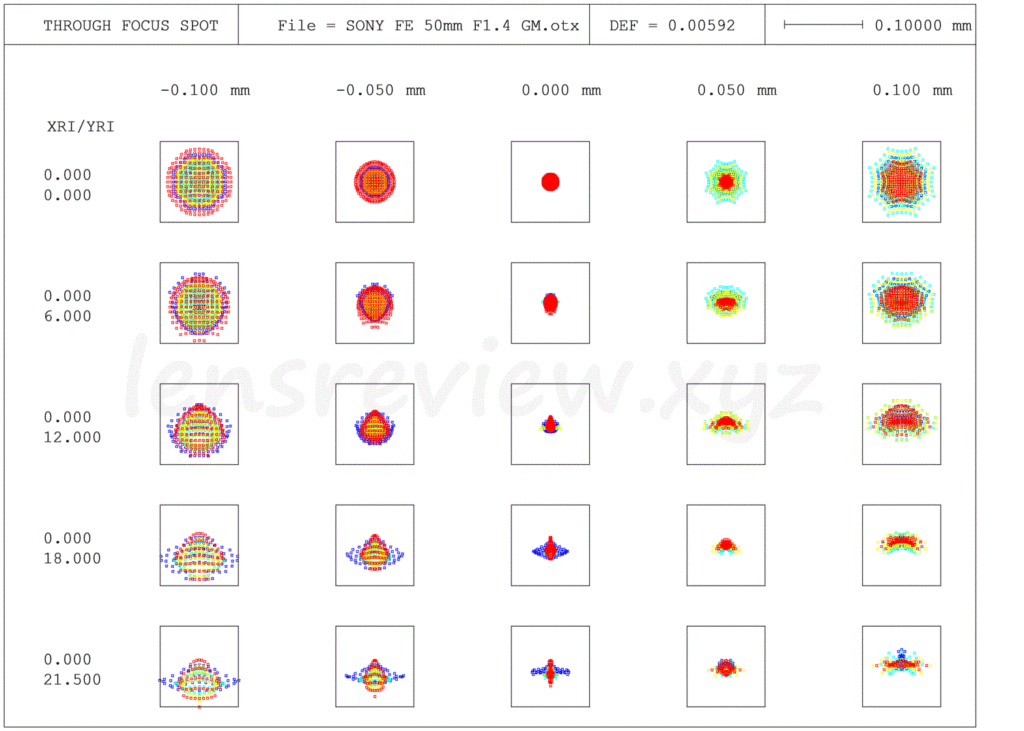
Switching to our high-resolution magnified scale, Detail Scale 0.1, allows us to analyze the core sharpness and micro-contrast. While a slight asymmetry becomes visible under this extreme magnification, the structural difference between the center of the frame (top row) and the extreme corners (bottom row) is incredibly minimal. To maintain such a uniform spot shape across the entire image circle at F1.4 is nothing short of extraordinary.
MTF Performance
Wide Open (Aperture: F1.4)
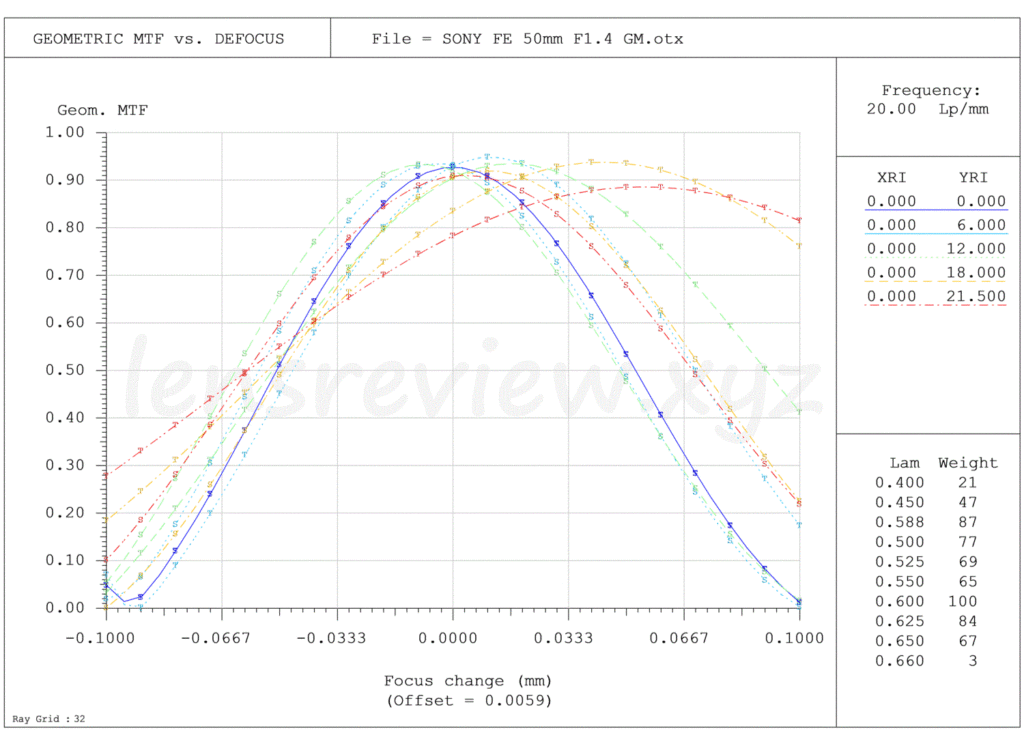
Our theoretical simulation at F1.4 reveals staggering performance. At the center of the frame (represented by the blue curve), the MTF value effortlessly sails past the 0.9 mark. Even out at a demanding image height of 18mm (the orange curve, representing the outer periphery), the MTF remains comfortably above 0.8. The balance between sagittal and tangential planes is highly synchronized, pointing to a uniform, high-contrast rendering style across the entire canvas.
Stopped Down (Aperture: F4.0)
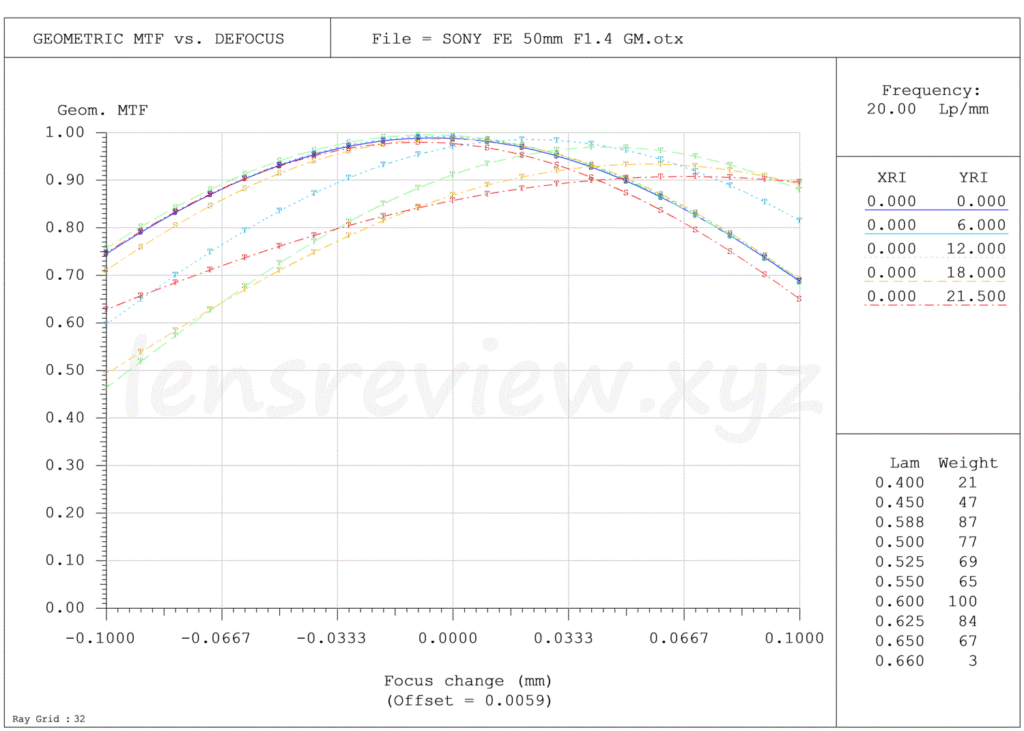
When stopping down to F4.0, optical physics dictates that most residual aberrations are clipped, leading to a natural boost in resolution. However, because the performance of the SONY FE 50mm F1.4 GM is already so close to the theoretical ceiling at F1.4, the shift to F4.0 brings no dramatic leap in sharpness. It is a luxurious engineering dilemma: when a lens is nearly perfect wide open, stopping down is merely a tool for controlling depth of field rather than fixing performance.
Conclusion
Sony's previous flagship prime, the FE 50mm F1.2 GM, was undoubtedly a spectacular technological achievement for an ultra-fast lens. However, when examining its MTF charts, one could sense the extreme strain and compromise required to tame an F1.2 aperture.
The FE 50mm F1.4 GM, on the other hand, represents the true sweet spot of modern lens design. By reigning in the aperture to a sensible F1.4, Sony’s engineers have crafted a lens that ruthlessly eliminates optical aberrations from edge to edge while successfully balancing weight, physical size, cost, and raw performance. As the definitive face of Sony's second-generation E-mount system, it stands out as a highly balanced masterpiece with zero vulnerabilities.

