


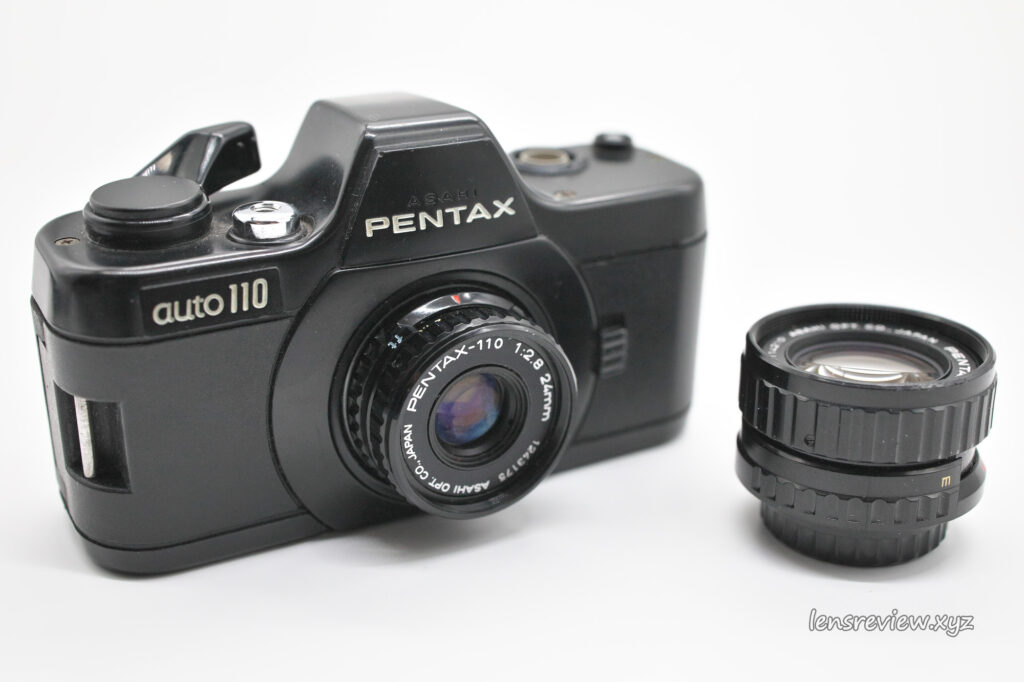
In this article, we will conduct a thorough design analysis of the PENTAX 110 20-40mm F2.8, a large-aperture standard zoom lens designed for the world’s only 110-system SLR, the PENTAX AUTO 110.
As an optical engineer, I will estimate the design values based on historical context and patent information to reveal the true optical performance that remains largely unknown.
1. Lens Overview
The PENTAX 110 20-40mm F2.8 was released in 1979 as the only zoom lens in the AUTO 110 lineup.
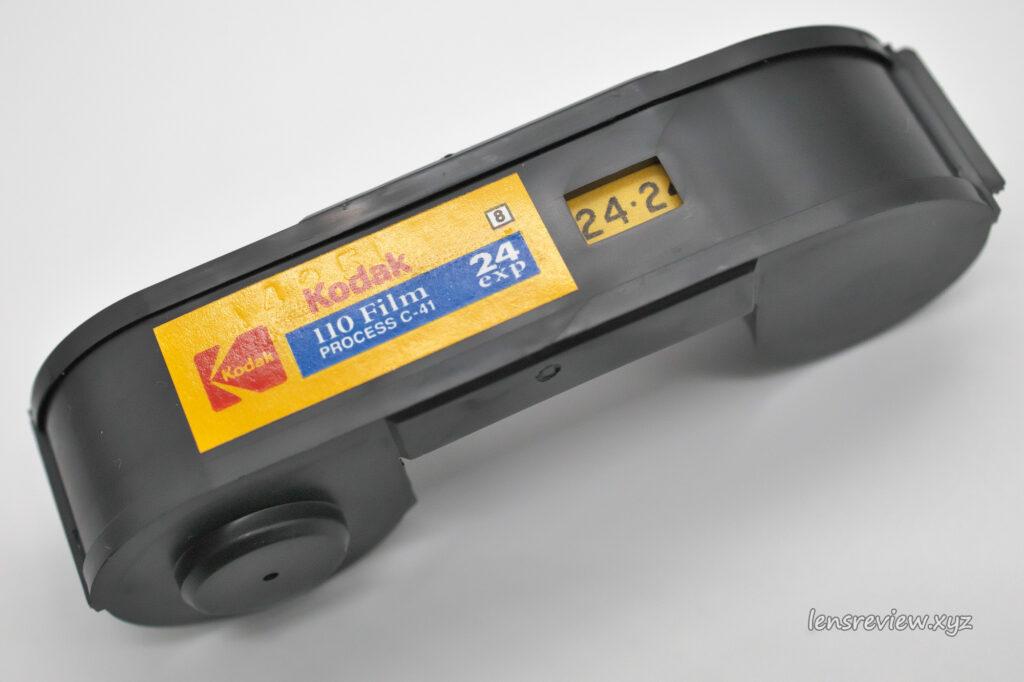
The 110 Film Format
The 110 format is roughly 1/4 the size of 35mm full-frame. With a diagonal length approximately half that of full-frame, this 20-40mm lens is equivalent to a 40-80mm standard zoom in 35mm terms.
The Challenge of F2.8
Maintaining a constant F2.8 aperture across the zoom range was an extraordinary feat for 1979. At that time, many major manufacturers had not yet released F2.8 standard zooms for the 35mm format. PENTAX achieved this in the tiny 110 format to compensate for the low ISO 100 sensitivity of 110 film, prioritizing brightness to ensure fast shutter speeds.

2. Patent Analysis & Design Values
Based on my research, this analysis is derived from Japanese Patent JP, S57-104108, Example 1.
Optical Path Diagram
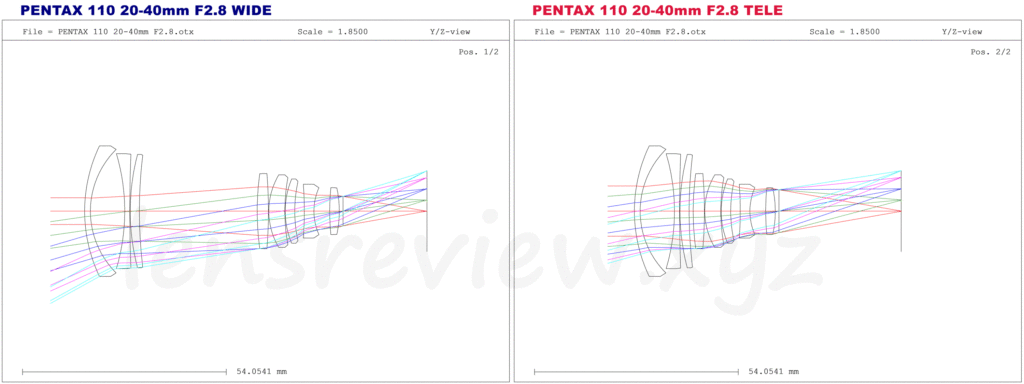
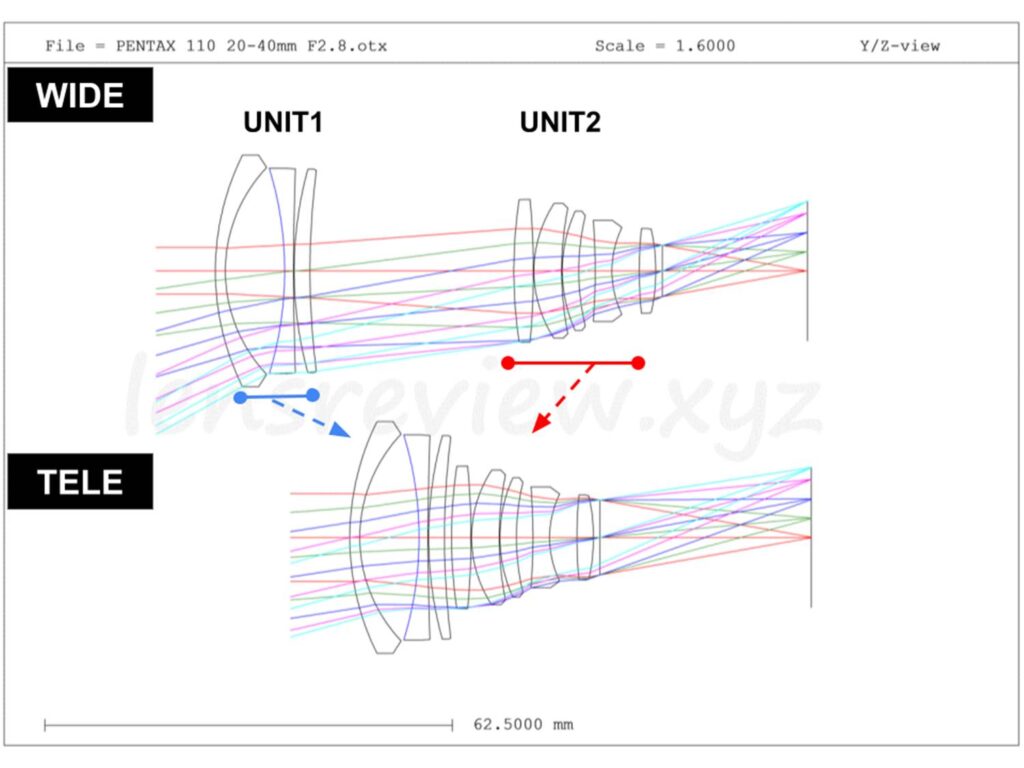
The lens construction consists of 8 elements in 8 groups. No aspherical elements are used, consistent with the era.
- Zoom Configuration: A 2-unit configuration. The first unit is a negative (concave) group that moves toward the sensor when zooming to the telephoto end. This "negative-lead" type is common in SLR standard zooms.
- The "Behind-the-Lens" Diaphragm: Unusually, the aperture is located at the very rear of the optical system. This "behind-the-lens diaphragm" is rarely seen in zoom lenses because it complicates aberration correction. It was likely adopted to keep the lens barrel extremely compact, integrated with the camera's shutter mechanism.
3. Simulation Data: Longitudinal Aberrations
Scales are adjusted to 35mm full-frame equivalents for comparison.
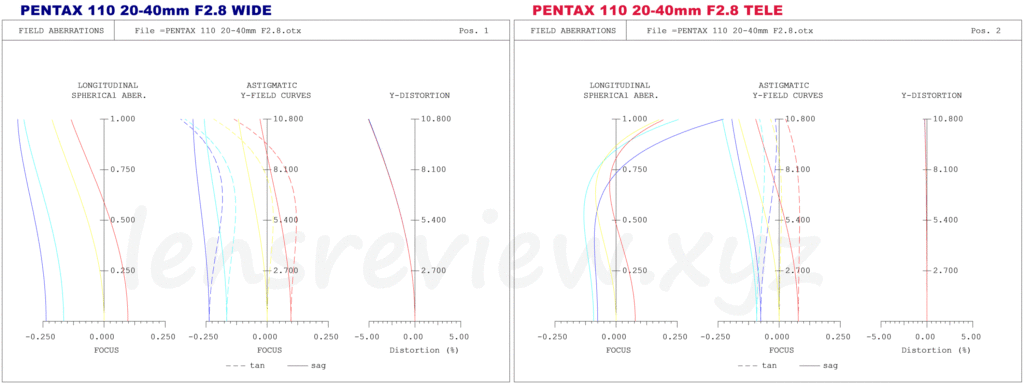
Spherical Aberration / Axial Chromatic Aberration
At the Wide end (20mm), spherical aberration shows a significant negative under-correction. Axial chromatic aberration is also present in substantial amounts. However, at the Tele end (40mm), the aberrations are better balanced, promising reasonable resolution.
Curvature of Field
While present, the curvature is not abrupt. Since the Wide end is equivalent to 40mm (not ultra-wide), the correction requirements were less extreme, resulting in a manageable profile.
Distortion
The Wide end shows approximately -5% barrel distortion. This is within acceptable limits for a consumer zoom lens. The Tele end shows near-zero distortion.
4. Spot Diagrams
Standard Scale: 0.15
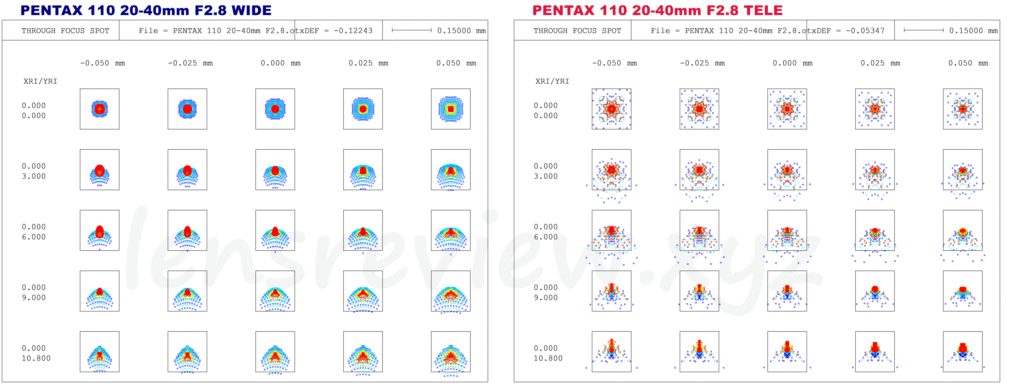
Despite the "messy" appearance in aberration graphs, the spot diagrams show a surprising level of consistency from the center to the periphery. PENTAX engineers did a remarkable job of balancing these rays.
Detail Scale: 0.03
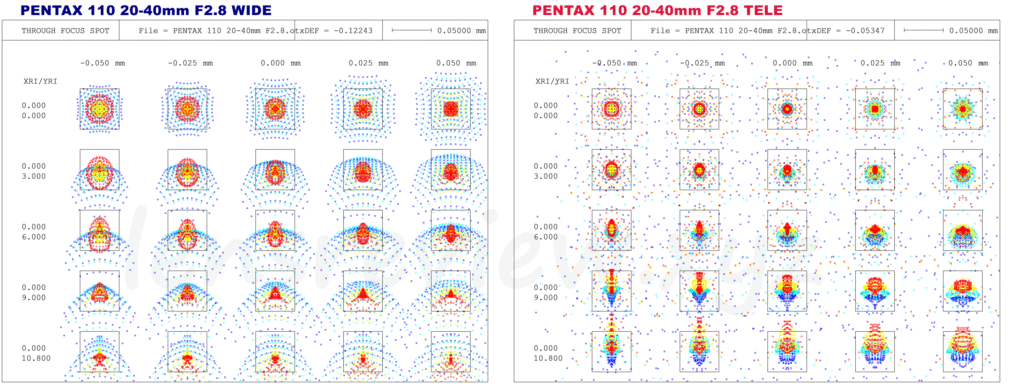
When viewed at this high magnification (intended for modern high-performance lenses), the spots appear large, reflecting the limitations of the era’s optical technology.
5. MTF Simulation (F2.8 vs. F4.0)
In this analysis, we examine the MTF at both maximum aperture and stopped down to F4.0.
At F2.8 (Full Open)
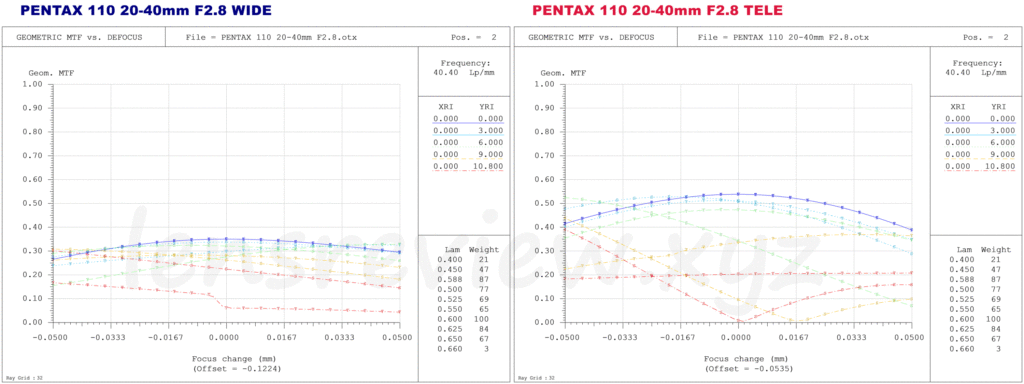
- Wide: Due to the influence of spherical aberration and comatic aberration, the MTF at the center is relatively low (around 0.4 at 30 lp/mm). The peripheral resolution drops further, typical of early zoom designs.
- Tele: As noted in the longitudinal aberration analysis, the telephoto end is better corrected than the wide end. It provides a crisp image at the center even at full aperture.
F4.0
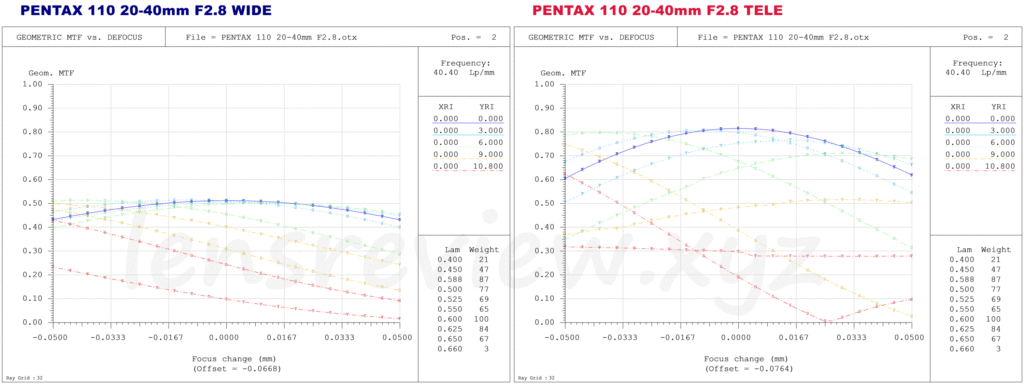
- Wide: By stopping down just one stop, the flare caused by spherical aberration is significantly suppressed. The contrast at the center shows a marked improvement, and the resolution in the mid-periphery becomes more stable.
- Tele: This is the "sweet spot" of the lens. The MTF values reach their peak across most of the frame. While the tiny 110 format often faces diffraction limits early, at F4.0, the balance between aberration correction and diffraction is optimal.
6. Conclusion
The PENTAX 110 20-40mm F2.8 was an unprecedented project: packing a constant F2.8 zoom into an impossibly small barrel. By utilizing a "behind-the-lens" diaphragm, Asahi Optical (PENTAX) proved their prowess as the leaders of the SLR world. While it lacks the surgical sharpness of modern optics, its engineering ambition remains a testament to the "PENTAX Pride."
Specifications
- Angle of View: 28.8° - 15.5°
- Construction: 8 elements / 8 groups
- Min. Aperture: F2.8 (Fixed)
- Min. Focus: 0.7m
- Filter Size: 49mm
- Weight: 174g
- Release Year: 1979
Analysis by Jin Takayama, LENS Review

